Longevity
Last Updated
Jun 15, 2026
Table of contents
You have two ages. One is printed on your birth certificate and moves forward whether you like it or not. The other is your biological age: how old your cells, organs, and systems actually behave, and it can run years ahead of or behind the calendar.
That second number is the one worth knowing. Studies of biological age find it predicts disease risk and lifespan more sharply than the years you have been alive, because it reflects the present state of your metabolism, your inflammation, and your organ function rather than just the date on your ID. Two people born the same week can sit a decade apart biologically.
It is also the only one of the two you can change. The habits you keep and the markers in your blood both move it, in either direction, which makes a high number a signal rather than a verdict. The calculator below estimates your biological age two ways: a fast lifestyle read that needs nothing but a minute, and a clinical-grade calculation built from a standard blood panel. Run whichever fits what you have in front of you, then read on for exactly how each number is built and how to act on it.
The 60-second estimate
Seven questions, no bloodwork. A directional read built from population research on what speeds up or slows down aging. For your true biological age, switch to the lab tab.
The clinical-grade number
The validated Levine PhenoAge algorithm: nine blood markers plus your age, the same model used in peer-reviewed aging research. Enter values from a standard CBC and metabolic panel. US lab units are pre-set.
Your biological age
Marker read-out
What moved your number
Want the number you can actually trust?
A lifestyle estimate is a mirror. Your blood is the measurement. OneTwenty runs quarterly labs, tracks your markers over time, and turns them into a plan.
Measure it with OneTwentyThis is not a medical diagnosis. The quick estimate is a directional, lifestyle-based model, not a clinical measurement. The lab calculation implements the Levine et al. (2018) PhenoAge algorithm for educational use; results depend on accurate, ideally fasting lab values and can be affected by acute illness, infection, dehydration, pregnancy, and medications. Always interpret biomarkers with a qualified clinician.
How this calculator works
There are two ways to answer the question "how old is my body," and this tool offers both. They serve different purposes, and the difference between them is the entire point.
The quick estimate asks seven questions about how you live. It needs no bloodwork and takes under a minute, so anyone can use it. The trade-off is that it reads your habits, not your biology. The lab-based calculation uses the Levine PhenoAge algorithm, a peer-reviewed model that reads nine markers from a standard blood panel. It is far more accurate because it measures what is happening inside you rather than inferring it from behavior.
Method 1: The quick estimate
The quick estimate is a transparent additive model. It starts from your chronological age and adds or subtracts years based on factors with well-established links to how fast people age and how long they live. Each answer carries a fixed adjustment in years. Positive numbers push your estimated age up, meaning you are aging faster than the calendar. Negative numbers pull it down.
| Factor | Option | Years applied |
|---|---|---|
| Smoking | Never / Former / Current | 0 / +1.5 / +6 |
| Physical activity (min/week) | None / under 75 / 75 to 149 / 150 to 300 / 300+ | +3 / +1.5 / 0 / -2 / -3 |
| Sleep (hrs/night) | under 5 / 5 to 6 / 7 to 8 / over 9 | +2.5 / +1 / -1.5 / +2 |
| Body composition (BMI) | under 18.5 / 18.5 to 24.9 / 25 to 29.9 / 30 to 34.9 / 35+ | +1 / -1 / +1 / +3 / +5 |
| Diet (fruit & veg/day) | 0 to 1 / 2 to 3 / 4 to 5 / 5+ | +1.5 / 0 / -1 / -2 |
| Stress | Low / Moderate / High | -1 / 0 / +2 |
The tool sums these adjustments, caps the total to a sensible band of roughly minus 12 to plus 15 years so no single profile produces an absurd result, and never returns an age below 18. The result panel shows you exactly which factors moved your number and by how much, so nothing is hidden in a black box.
Be clear about what this is. It is a directional reflection of your habits, not a measurement of your physiology. Two people can give identical answers and have very different inflammation, blood sugar control, and organ function. The quick estimate cannot see any of that. For the number that can, use the lab tab.
Method 2: The lab-based PhenoAge
This is the rigorous one. PhenoAge was developed by Morgan Levine and colleagues and published in 2018. It was built on a large US population dataset, NHANES, and validated against real outcomes: it predicts mortality and age-related disease risk, and it distinguishes between two people of the same chronological age who are aging at different rates. It uses nine routine blood markers plus your age.
| Biomarker | What it reflects | When elevated |
|---|---|---|
| Albumin | Liver function, protein and nutritional status | Higher reads younger |
| Creatinine | Kidney function and muscle metabolism | Very high reads older |
| Glucose | Blood sugar and metabolic health | Higher reads older |
| hs-CRP | Systemic inflammation | Higher reads older |
| Lymphocyte percent | Immune function | Higher within range reads younger |
| Mean cell volume (MCV) | Average red blood cell size | Higher reads older |
| Red cell distribution width | Variability in red cell size | Higher reads older |
| Alkaline phosphatase | Liver and bone activity | Higher reads older |
| White blood cell count | Immune activity and inflammation | Higher reads older |
The calculation runs in three steps. First it combines the markers into a single weighted score. Then it converts that score into a 10-year mortality risk. Finally it maps that risk back onto the age scale, answering the question "what age does this risk profile correspond to in the general population." The exact formula is below.
The CRP detail most calculators get wrong
The PhenoAge model was fit on CRP measured in milligrams per deciliter (mg/dL). US labs, including the panels OneTwenty runs, report hs-CRP in milligrams per liter (mg/L), a number ten times larger. A surprising number of public calculators feed the mg/L value straight into the formula without converting it, which inflates the score and systematically reports people as older than they are. This calculator converts your mg/L value to mg/dL before taking the logarithm, so the result matches the published algorithm. You enter the value exactly as your lab reports it and the math handles the rest.
How to read your result
The headline number is your biological age. The number that matters most is the gap between it and your chronological age.
If your biological age is lower than your real age, your body is running ahead of the calendar, which is associated with lower disease and mortality risk. If it is higher, your biology is aging faster than your years, which is a signal worth taking seriously and, importantly, often reversible. A gap within about a year in either direction means you are tracking with your age. The further the gap opens, the stronger the signal.
One reading is a single data point. It tells you where you stand today. It does not tell you which direction you are heading, and direction is what you can actually change.
What can move the number around
The lab calculation is only as good as the values you feed it. Glucose should ideally be a fasting value, since a reading taken after a meal runs higher and inflates the result. Acute illness, a recent infection, or an injury can spike CRP and white blood cell count, temporarily making you look older, so avoid testing while sick. Dehydration, a very intense recent workout, pregnancy, and certain medications can all shift individual markers. Labs also differ slightly in their methods and reference ranges, so small run-to-run variation is normal.
This is why a single snapshot is a weaker tool than a trend. Markers tracked over time, under similar conditions, tell a far more reliable story than any one test.
Estimate versus measurement
The quick estimate is a mirror. It reflects your habits back at you, and that has real value as a gut check. But habits are an input, not an outcome. Your blood is the outcome. It shows the actual state of your inflammation, your metabolic health, your kidney and liver function, the things you cannot feel and cannot guess.
Stop estimating. Start measuring.
OneTwenty runs quarterly lab panels covering the nine markers behind your PhenoAge, tracks them across time so you see the trend instead of a lone dot, and turns the results into a concrete plan. The goal is simple: the next time you check, the number has moved, and it moved on purpose.
Measure your biological ageFrequently asked
What is the difference between biological and chronological age?
Chronological age is simply how long you have been alive. Biological age estimates how old your body behaves at the cellular and organ level. Two people born on the same day can have biological ages a decade apart, because lifestyle and underlying health shift how fast the body ages.
How accurate is the quick estimate?
It is directional, not diagnostic. It captures behaviors with strong links to aging and longevity, but it cannot see what is happening inside your body. Treat it as a useful gut check, and use the lab-based calculation for an actual measurement.
What blood tests do I need for the PhenoAge calculation?
A standard complete blood count (CBC) and a metabolic panel cover almost all of it: albumin, creatinine, glucose, lymphocyte percent, mean cell volume, red cell distribution width, alkaline phosphatase, and white blood cell count. The one addition is high-sensitivity CRP (hs-CRP), an inflammation marker that is often ordered separately.
Can I lower my biological age?
Yes, and that is the point. Unlike chronological age, biological age responds to inputs: sleep, training, body composition, blood sugar control, and inflammation. Improving the markers behind the score moves the number, which is why tracking it over time is more useful than a single reading.
Is my data saved?
No. The entire calculation runs in your browser. Nothing you enter is stored or sent anywhere.
Levine ME, Lu AT, Quach A, et al. An epigenetic biomarker of aging for lifespan and healthspan. Aging (Albany NY). 2018;10(4):573-591.
Liu Z, Kuo P-L, Horvath S, Crimmins E, Ferrucci L, Levine M. Correction: A new aging measure captures morbidity and mortality risk across diverse subpopulations from NHANES IV. PLoS Medicine. 2019. Source of the corrected PhenoAge equation used above.
This page is for education, not medical diagnosis. The quick estimate is a directional, lifestyle-based model and not a clinical measurement. The lab calculation implements a published research algorithm. Results depend on accurate, ideally fasting lab values and can be affected by acute illness, infection, dehydration, pregnancy, and medications. Always interpret biomarkers with a qualified clinician. Nothing on this page is a substitute for professional medical advice.
Not your average
Checkup.
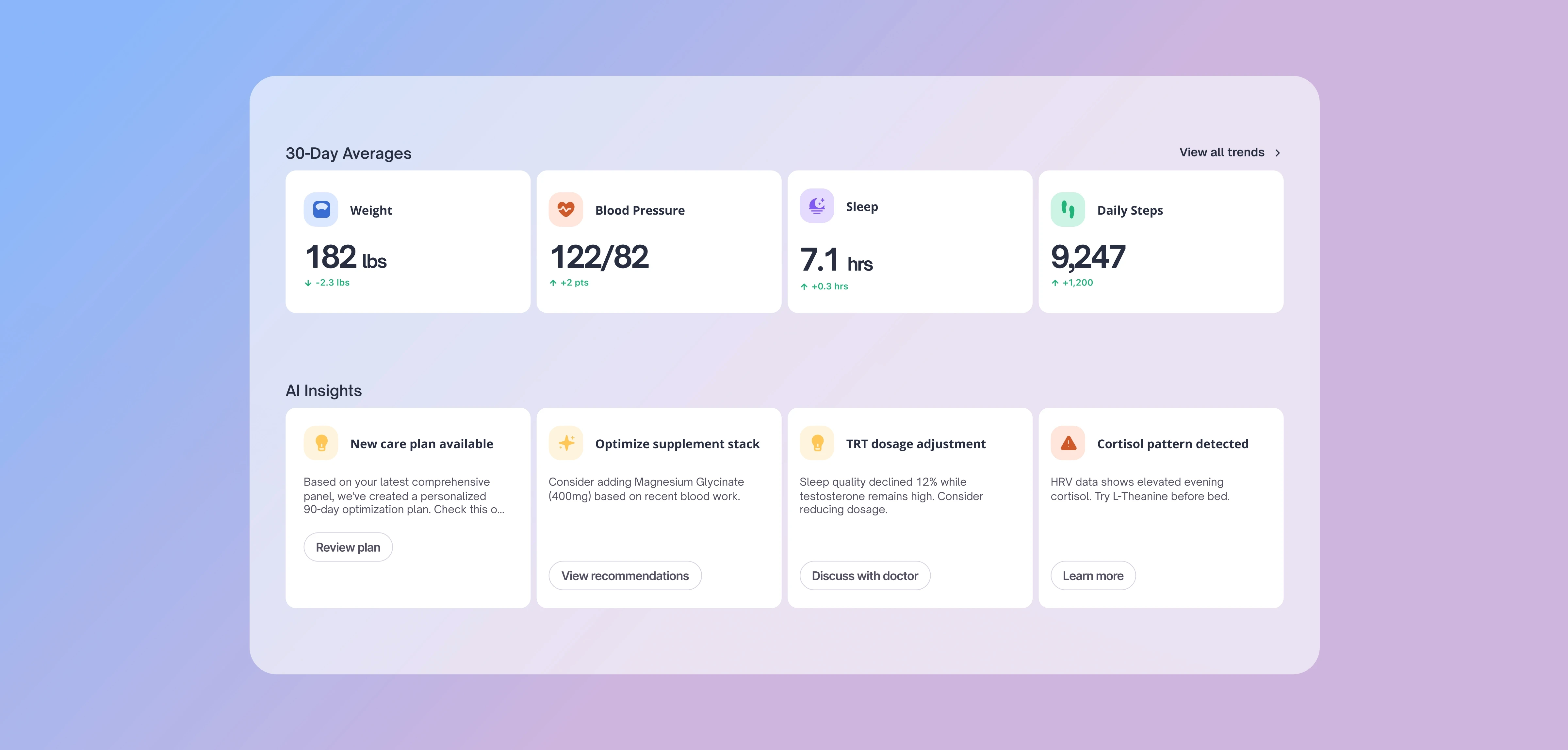
Every life stage brings new biological demands. Tracking the right metrics at the right time helps you adapt, optimize performance, and extend both lifespan and healthspan.
Your Annual Physical
Manual Data Processing
Guesswork Trend Detection
Once-a-year physical
Reactive, tested when sick
No data between visits
Once a year testing
Delayed Results
One-size dosing, set and forget
Real-Time Trend Insights
Daily smart-device data
Automated Data Sync
Quarterly Biomarker Tests
Optimal, personalized targets
Plain-language AI insights
Medications titrated to your data
Built to extend healthspan

Frequently Asked Questions
Clarity before
you commit
Answers on setup, scale, and support to remove blockers.